
What Really Matters for Success: What Research Actually Shows
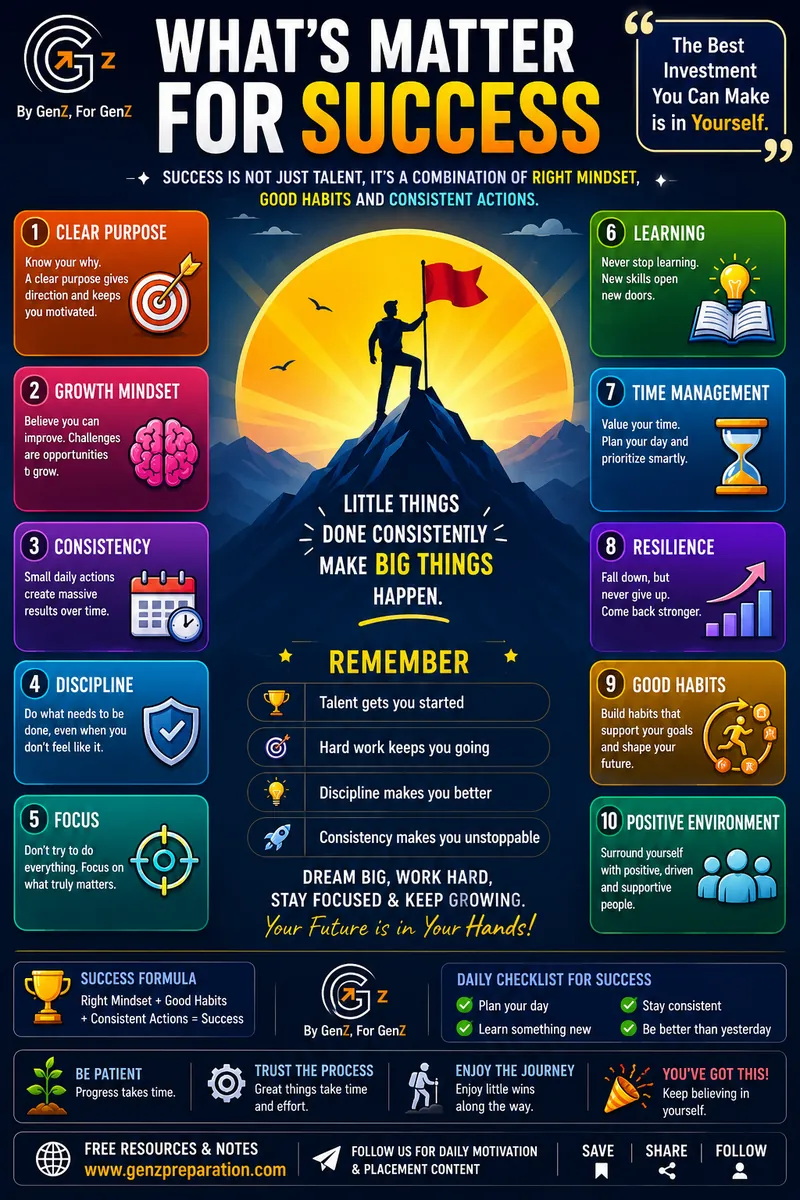
Every student has heard some version of "hard work beats talent" at least a hundred times. It sounds nice, but it's also vague enough to be useless. So instead of another motivational pep talk, let's look at what psychology research and real hiring data actually say matters for success — and what that means for you as a student preparing for placements.
Talent Gets You Started. Consistency Gets You There.
Psychologist Angela Duckworth spent years studying why some people achieve long-term goals while equally talented people don't. Her research on grit — defined as passion and perseverance for long-term goals — found something surprising: grit predicted success better than IQ in several studies, across students, salespeople, and even military cadets.
Grit isn't about being intense for one week before an exam and burning out. It has two parts:
- Perseverance of effort — showing up and doing the work even after a bad week or a failed mock test
- Consistency of interest — sticking with the same goal over months instead of switching direction every time something feels hard
For placement prep specifically, this means one thing: a student who solves 5 aptitude questions daily for 3 months will almost always outperform one who does 50 questions in a single weekend before the test. Consistency compounds. Intensity burns out.
Marks Matter Less Than You Think — Skills Matter More
This part often surprises students. According to NACE's Job Outlook 2026 survey, the percentage of employers screening candidates by GPA has dropped from 73% in 2019 to just 42% today. Instead, 70% of employers now use skills-based hiring for entry-level roles — up from 65% the year before.
What are they actually testing for instead? The same surveys consistently rank these as the top predictors of who gets hired and who succeeds after being hired:
- Analytical thinking — breaking a problem into parts and reasoning through it, which is exactly what aptitude and pseudocode rounds test
- Communication — explaining your thinking clearly, in interviews and in day-to-day work
- Problem-solving under pressure — staying calm and logical when a question doesn't go as expected
- Adaptability — learning new tools and formats quickly instead of only relying on what you memorized
This is good news, honestly. Marks are locked in by the time you're preparing for placements. Skills are not — they're built through practice, and practice is something you fully control.
The Real Differentiator: A Growth Mindset
Research on mindset (also from Duckworth's field of work) shows that students who treat setbacks as information rather than judgment improve faster than students who see a bad mock score as proof they're "not good enough." A wrong answer isn't a verdict on your ability — it's just a signal pointing to exactly what to practice next.
This is also why gritty, consistent students tend to handle interview rejections better. They don't stop after one "no" — they treat it as one data point in a longer process.
How to Actually Apply This (Not Just Read It)
- Pick one thing and practice it daily, even for 20 minutes. A short daily session on GenZprep's practice sections beats a single 4-hour cram session before a test.
- Track your mistakes, not just your score. Every wrong answer is more useful than a right one — it tells you exactly what to fix.
- Practice explaining your answers out loud. This builds the communication skill that interviews and GD rounds actually test.
- Don't quit a topic just because week one felt hard. Most improvement happens after the point where it stops feeling fun.
- Treat rejection as a checkpoint, not a verdict. Every company has a different bar — one "no" tells you nothing about the next "yes."
How GenZprep Helps
We built GenZprep around exactly this idea: small, consistent, focused practice beats last-minute cramming. Our company-wise practice sections let you build the analytical thinking and pattern recognition that actual assessments test, section by section, at your own pace — with instant feedback so every mistake teaches you something immediately.
Final Tip
Success isn't a personality trait some people are born with. It's mostly a handful of repeatable habits — consistency, honest self-review, and treating setbacks as feedback instead of failure. Start small, stay consistent, and let the process do the work.
You don't need to be the smartest person in the room. You just need to show up more consistently than the version of yourself from last month.
Ready to practice?
Try our free placement practice tests or check current job openings.